
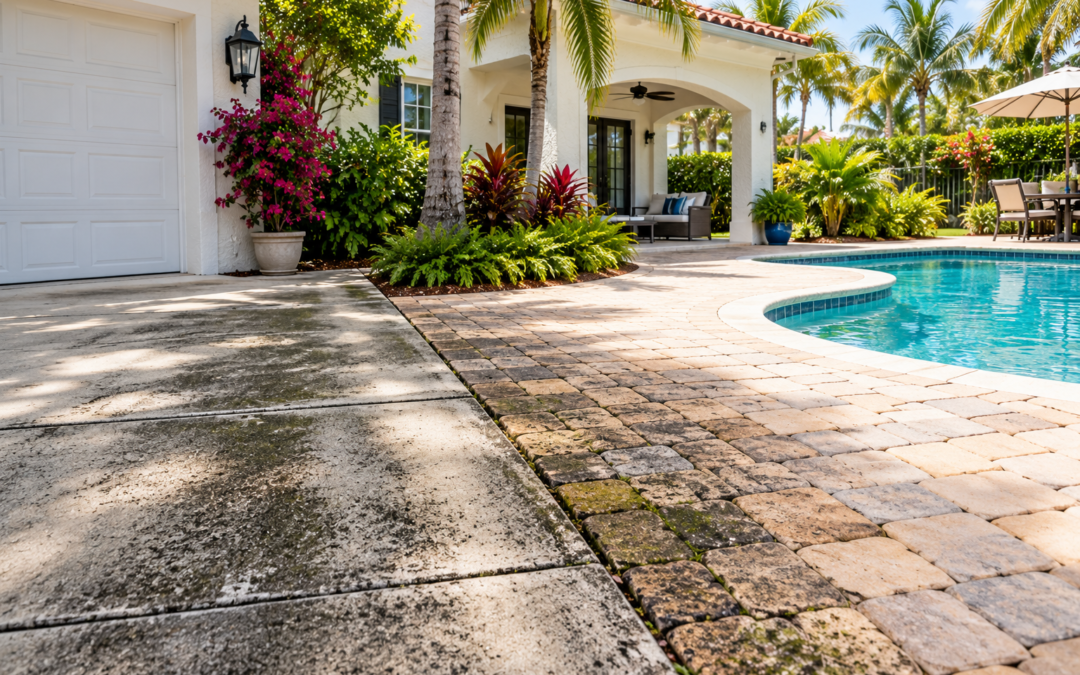
You clean your driveway. It looks bright again.
Then South Florida happens.
Rain returns. Humidity stays high. Irrigation runs several times a week. Tropical landscaping creates shade around the property. Before long, light gray concrete begins turning dark again, pavers lose their original color and green or black discoloration starts appearing around the pool deck.
For homeowners in Lake Worth Beach, this is an extremely common exterior maintenance problem.
The dark staining found on driveways, sidewalks, pavers and pool areas isn’t always ordinary dirt. Organic growth, moisture, environmental debris and other contaminants can all contribute to the gradual discoloration of outdoor surfaces.
And South Florida provides plenty of the conditions that encourage that buildup.
Professional driveway and paver cleaning can dramatically improve the appearance of a property, but understanding why these surfaces become dirty so quickly can also help homeowners determine when cleaning is needed and why certain areas of the property seem to get dirty faster than others.
Why Do Lake Worth Beach Driveways Turn Black?
Concrete looks incredibly solid.
Look closely, however, and you’ll see that concrete isn’t a perfectly smooth, nonporous material.
Its surface contains tiny pores and irregularities where moisture, dirt and organic material can accumulate.
Now combine that surface with Lake Worth Beach’s climate.
Warm temperatures.
High humidity.
Frequent rain.
Irrigation.
Shade.
Tropical vegetation.
Those conditions help organic contamination develop across exterior surfaces.
A driveway usually doesn’t turn black overnight.
The change happens gradually.
Because homeowners see their driveway every day, they may not realize how much darker it has become until a section is professionally cleaned.
That’s when the contrast can be dramatic.
It’s Not Always Just Dirt
A common assumption is that a black driveway is simply dirty from vehicle traffic.
Vehicles certainly contribute contaminants, especially around parking areas.
But ordinary dirt isn’t the only reason South Florida concrete becomes discolored.
Organic growth can create widespread dark or green staining across concrete surfaces.
That’s why you’ll sometimes see a driveway where sections that rarely have vehicles parked on them are just as dark—or darker—than the parking area.
The environment itself is contributing to the problem.
Florida Humidity Plays a Major Role
Moisture is one of the biggest factors affecting exterior surfaces in Palm Beach County.
Florida humidity means surfaces don’t have to experience direct rainfall to encounter moisture.
Morning dew can leave concrete damp.
Humid air slows evaporation.
Shaded areas may stay wet longer.
Then an afternoon storm arrives and starts the process over again.
When surfaces repeatedly remain damp, organic growth has a better opportunity to develop.
This is one reason exterior cleaning is such a routine part of property maintenance in South Florida.
Why Rain Doesn’t Clean Your Driveway
It seems logical.
If rain is water falling from the sky, shouldn’t frequent rain naturally wash a driveway?
Not really.
Rain may rinse away some loose dust and debris, but it doesn’t provide the professional cleaning necessary to remove established organic contamination.
Rain also creates moisture.
During South Florida’s wetter periods, a driveway may repeatedly become saturated and remain damp for extended periods.
Those conditions can actually contribute to the environment that allows organic growth to flourish.
So a rainy summer doesn’t mean your driveway is getting a free pressure washing.
Quite the opposite.
You may notice dark staining becoming more obvious as the wet season progresses.
Shade Can Make One Side of a Driveway Dirtier
Have you ever noticed that one section of your driveway turns black faster than another?
Look at the sunlight.
A section receiving several hours of direct Florida sun may dry relatively quickly after rain.
Another area beneath a large tree or beside the house may remain shaded for much of the day.
That shaded concrete can stay damp longer.
Mature palms, oaks, hedges and tropical landscaping can all influence how much sunlight reaches a surface.
This explains why two neighboring homes—or even two sides of the same driveway—can develop staining at completely different rates.
Irrigation Can Contribute to Exterior Staining
Irrigation is essential for maintaining many South Florida landscapes.
But sprinklers don’t always keep water perfectly on the grass.
Overspray may repeatedly hit driveways, sidewalks, walls and pavers.
That means certain sections of the property can become wet even when it hasn’t rained.
Depending on the water source, irrigation may also contribute to mineral or rust-colored staining.
Those orange and brown stains are different from the black or green organic growth commonly found on damp surfaces and may require a different treatment.
Identifying what caused the stain is important because not every type of discoloration should be approached exactly the same way.
Why Pavers Get Dirty So Quickly in Lake Worth Beach
Pavers are extremely popular throughout Palm Beach County.
They fit naturally with Florida architecture and can create beautiful driveways, walkways, patios and pool areas.
But pavers present some unique cleaning challenges.
The surface itself can accumulate organic contamination.
Then there are the joints.
Moisture and debris can collect between individual pavers, creating additional areas where growth can develop.
Over time, bright paver colors may become muted beneath environmental buildup.
A driveway that originally had distinct reds, tans, browns or grays may gradually take on a darker, more uniform appearance.
Professional cleaning can remove much of that surface contamination and reveal the colors underneath.
Why Pavers Can Look Older Than They Really Are
Sometimes homeowners assume faded-looking pavers need to be replaced.
They may simply be dirty.
Years of environmental buildup can dramatically change the appearance of the surface.
Dark organic staining reduces contrast between individual pavers and hides much of the original color.
Once cleaned, homeowners are often surprised by how different the hardscape looks.
Cleaning won’t repair cracked, damaged or deteriorated pavers, and it won’t restore material that has actually lost its original color.
But removing surface contamination can make a significant visual difference when buildup is the primary problem.
Should Pavers Be Pressure Washed?
Pavers can be professionally pressure cleaned, but technique matters.
More pressure isn’t automatically better.
Excessive or careless pressure can disturb joint material and create an uneven cleaning pattern.
The condition of the pavers, joints and surrounding areas should be evaluated before cleaning begins.
Professional equipment allows the cleaning method to be adjusted according to the surface rather than simply using maximum pressure everywhere.
Why Pool Decks Develop Green and Black Staining
A pool deck exists in a moisture-rich environment by definition.
Water splashes onto the surface.
Swimmers walk across it wet.
Rain adds additional moisture.
Landscaping may create shade around portions of the pool.
Covered lanais can reduce direct sunlight.
Then South Florida humidity adds another layer.
These conditions can contribute to organic growth and discoloration around the pool area.
Because pool decks are highly visible outdoor living spaces, even moderate staining can make an otherwise beautiful backyard look less maintained.
Dirty Pool Decks Can Become Slick
Appearance isn’t the only reason homeowners clean pool decks.
Organic buildup on frequently wet walking surfaces can become slick.
Areas near steps, walkways and shaded portions of a pool deck deserve particular attention.
Professional cleaning removes accumulated contamination and restores a cleaner walking surface.
Of course, any wet surface can still be slippery, so cleaning doesn’t eliminate the need for normal caution around a pool.
Different Pool Deck Materials Need Different Cleaning Methods
Not every pool deck is poured concrete.
South Florida properties may have pavers, textured coatings, decorative concrete or other materials around the pool.
Those surfaces shouldn’t automatically receive identical pressure.
Professional exterior cleaning begins by identifying what is being cleaned.
Durable concrete may tolerate a different process from a coated or more delicate surface.
This is the same principle we use throughout a property.
The surface determines the method.
Why a Pressure-Washer Wand Can Leave Stripes
You’ve probably seen this before.
A homeowner pressure washes a driveway and the finished concrete has light and dark lines running across it.
Those marks are often caused by inconsistent cleaning with a wand.
The nozzle may be closer to the concrete during one pass and farther away during another.
The operator may move more slowly across certain sections.
Passes may overlap unevenly.
The result can be obvious stripes or “cleaning lines.”
Professional driveway cleaning often uses surface-cleaning equipment designed to clean broader areas more consistently.
What Is a Surface Cleaner?
A professional surface cleaner is designed specifically for flat hard surfaces such as concrete.
Rather than cleaning a driveway one narrow wand pass at a time, the equipment cleans a wider area using rotating spray components beneath a housing.
This can create a more consistent cleaning pattern and significantly improve efficiency on large surfaces.
The exact equipment and process depend on the property, but surface cleaning is one reason professional driveway cleaning looks different from someone spending Saturday afternoon drawing lines across concrete with a small residential machine.
Pressure Washing vs. Soft Washing Hardscapes
We talk frequently about soft washing because it’s important for house exteriors and roofs.
Driveways are different.
Durable concrete can generally tolerate professional pressure cleaning when performed correctly.
That doesn’t mean cleaning solutions have no role.
Organic contamination may still benefit from appropriate treatment.
Professional exterior cleaning isn’t about choosing between “chemicals” and “pressure.”
It’s about using the right combination of cleaning solution, pressure, water flow and equipment for the contamination and surface involved.
What About Oil Stains?
Oil is different from algae.
A driveway can be professionally cleaned and still have discoloration from deeply absorbed automotive fluids.
Fresh surface contamination may respond differently from an old oil stain that has penetrated porous concrete over a long period.
Homeowners should have realistic expectations.
Professional pressure washing can dramatically improve a dirty driveway, but it doesn’t guarantee that every permanent or deeply absorbed stain will completely disappear.
The type and age of the stain matter.
What About Rust and Irrigation Stains?
Orange or rusty discoloration is another common South Florida problem.
These stains may be associated with irrigation water or metal contamination and aren’t the same as black organic buildup.
Simply increasing water pressure isn’t always the correct solution.
Specialized stain treatment may be required depending on what’s causing the discoloration.
This is another reason diagnosing the stain matters.
A professional shouldn’t treat every color on a driveway as the same contaminant.
Driveway Cleaning Can Transform Curb Appeal
The driveway occupies a huge portion of the front of many Florida properties.
That makes its condition important to the overall appearance of the home.
You can have fresh exterior paint and beautiful landscaping, but a heavily blackened driveway will still stand out.
Cleaning it can create one of the most immediate curb-appeal improvements available through exterior maintenance.
The contrast is particularly noticeable on lighter concrete.
Don’t Forget the Sidewalk
A freshly cleaned driveway next to a dark sidewalk can make the sidewalk look even dirtier.
That’s why homeowners frequently choose to clean connecting hard surfaces together.
Driveways.
Entrance walkways.
Sidewalks.
Front patios.
Porches.
Cleaning the visible surfaces as a group creates a more uniform finished appearance.
Paver Patios and Outdoor Living Areas
Lake Worth Beach homeowners spend a lot of time outdoors.
Patios and backyard living spaces function almost like additional rooms.
Outdoor furniture, grills, planters, trees and surrounding landscaping can all contribute to surface buildup.
Covered patios may receive less rain but also less sunlight.
That means shaded portions can stay damp and develop organic staining.
Professional cleaning can refresh these areas without requiring replacement or major renovation.
Cleaning Hardscapes Before Selling a Home
Exterior cleaning can be especially valuable before listing a property.
Buyers form opinions before entering the home.
The driveway is often one of the first surfaces they see.
A dark driveway, stained walkway or dirty pool deck can make an otherwise well-maintained property feel tired.
Professional cleaning can brighten these existing surfaces before listing photography and showings.
For sellers, combining driveway cleaning with house washing and roof cleaning can create a much more complete exterior transformation.
Cleaning Pavers Before Entertaining
Not every cleaning project needs to be tied to selling a home.
Sometimes you simply want the backyard to look good.
Florida’s outdoor season lasts much longer than in most parts of the country.
Family gatherings, cookouts, pool parties and holidays frequently spill into outdoor living areas.
Cleaning patios, pavers and pool decks can quickly refresh the space before guests arrive.
How Often Should Lake Worth Beach Driveways Be Cleaned?
There isn’t one correct answer.
Some driveways develop visible organic growth faster than others.
A fully exposed concrete driveway may remain cleaner longer because sunlight helps it dry.
A shaded driveway surrounded by mature landscaping may darken much faster.
Irrigation, drainage, tree cover, surface material and environmental exposure all affect cleaning frequency.
Instead of focusing exclusively on a calendar, look at the surface.
When the driveway noticeably darkens, green growth appears or the contrast between exposed and protected areas becomes obvious, it’s probably time to consider cleaning.
How Often Should Pavers Be Cleaned?
Pavers also vary considerably.
A shaded backyard patio may develop organic contamination faster than an open front walkway.
Pool pavers experience frequent moisture.
Driveway pavers deal with vehicles and environmental buildup.
The best maintenance schedule depends on the specific property.
Routine cleaning prevents years of contamination from accumulating and helps homeowners maintain the appearance of their hardscapes.
Why Two Lake Worth Beach Homes Can Need Different Cleaning Schedules
Your neighbor may clean their driveway more or less frequently than you do.
That doesn’t mean either homeowner is doing something wrong.
Every property has a slightly different microenvironment.
One may have an enormous tree covering half the driveway.
Another may have no shade at all.
One irrigation system may spray directly across the pavers.
Another may keep water completely within the landscaping.
One backyard may receive direct afternoon sunlight.
Another may remain shaded behind the house.
Exterior maintenance should respond to the actual property rather than following a one-size-fits-all schedule.
Professional Cleaning vs. DIY Pressure Washing
A homeowner can purchase or rent a pressure washer.
The bigger question is whether doing so produces the same result.
Professional equipment typically provides greater water flow, specialized attachments and cleaning capabilities designed for larger exterior surfaces.
Experience also matters.
Knowing how close to hold a nozzle, which tip to use, how to avoid damaging adjacent materials and how to create consistent results takes practice.
A DIY machine may be sufficient for small projects.
For heavily stained driveways, large paver areas or an entire property, professional cleaning can save significant time while producing a more uniform result.
Can Pressure Washing Damage Concrete?
Improper pressure washing can damage surfaces.
Concrete is durable, but it isn’t indestructible.
Using excessive pressure, holding a concentrated nozzle too close or cleaning newer or compromised concrete incorrectly can etch the surface.
Professional cleaning doesn’t mean using as much pressure as the machine can produce.
It means using an appropriate amount for the surface and condition.
Cleaning Around Older Lake Worth Beach Homes
Lake Worth Beach has many established and older properties, which makes surface selection particularly important.
A durable concrete driveway may be professionally pressure cleaned while the older stucco house beside it receives a gentler soft wash.
Decorative features may require additional care.
Older painted walls shouldn’t be treated as extensions of the driveway.
A professional exterior cleaning plan can use several techniques on the same property.
That’s exactly how it should be.
Lake Worth Beach’s Climate Isn’t Going Away
You can’t stop humidity.
You can’t prevent rain.
You can’t keep every leaf from falling onto a driveway.
And you probably don’t want to remove every palm or tropical plant just so more sunlight reaches your pavers.
Exterior contamination is part of owning property in South Florida.
The solution isn’t trying to eliminate the environment.
It’s maintaining the surfaces exposed to it.
Professional cleaning removes accumulated contamination and gives the property a fresh starting point.
Eventually, environmental buildup will return.
When it becomes noticeable again, the surfaces can be maintained.
Professional Driveway Cleaning in Lake Worth Beach, FL
Burk’s Pressure Cleaning provides professional driveway cleaning, paver cleaning, pool deck cleaning and exterior pressure washing throughout Lake Worth Beach and surrounding Palm Beach County communities.
We don’t treat every surface exactly the same.
Concrete, pavers, coated pool decks, stucco and roofing each have different cleaning requirements.
Our goal is to identify what needs to be cleaned and use an appropriate process for that surface.
Whether your driveway has turned black, your pavers have lost their original color or your pool deck is developing green organic growth, professional cleaning can make a dramatic difference.
Frequently Asked Questions About Driveway and Paver Cleaning
Why is my Lake Worth Beach driveway turning black?
Moisture, organic growth, environmental debris, shade and South Florida’s humid climate can all contribute to dark discoloration on concrete.
Does rain clean algae off concrete?
Rain may rinse away loose dirt, but it doesn’t replace professional cleaning. Repeated rainfall also keeps surfaces moist, which can contribute to conditions favorable for organic growth.
Can you pressure wash pavers?
Yes. Pavers can be professionally cleaned, but pressure and technique should be appropriate for the condition of the pavers and joints.
Why are my pavers green?
Green discoloration is commonly associated with organic growth, particularly in shaded areas that remain damp for longer periods.
Can pressure washing remove oil stains?
Professional cleaning can improve many driveway stains, but deeply absorbed or permanent automotive staining may not disappear completely.
Can you remove irrigation stains?
Some irrigation and rust-colored stains require specialized treatment beyond ordinary pressure washing. The cause and condition of the stain determine the appropriate approach.
Why does my pool deck keep turning green?
Pool decks receive frequent moisture from swimming, rain and humidity. Shade and nearby landscaping can allow certain sections to remain damp longer and develop organic growth.
Is a surface cleaner better than a pressure-washing wand for driveways?
Professional surface cleaners are designed to clean larger flat areas more consistently and can reduce the striping associated with inconsistent wand cleaning.
How often should I pressure wash my driveway in Lake Worth Beach?
It depends on the individual property. Shade, irrigation, vegetation, drainage and moisture exposure all affect how quickly staining returns.
Can you clean my house at the same time as my driveway?
Yes. Burk’s Pressure Cleaning can combine driveway cleaning with house washing, roof cleaning, paver cleaning, pool deck cleaning and other exterior services.
Do you serve areas outside Lake Worth Beach?
Yes. We provide exterior cleaning throughout Palm Beach County, including Wellington, Royal Palm Beach, Loxahatchee, West Palm Beach, Palm Beach Gardens, Jupiter and surrounding communities.
Get a Free Driveway Cleaning Estimate in Lake Worth Beach
If your driveway no longer looks like the concrete you remember, you probably aren’t imagining it.
South Florida’s combination of humidity, rain, irrigation, vegetation and year-round warm weather can gradually cover hardscapes with dark and green organic staining.
Burk’s Pressure Cleaning can help bring those surfaces back.
We provide professional driveway cleaning, paver cleaning, pool deck cleaning, patio cleaning and pressure washing throughout Lake Worth Beach, Florida.
And if the rest of the property needs attention, we also provide professional house washing and roof cleaning using methods appropriate for those more sensitive surfaces.
Contact Burk’s Pressure Cleaning at (561) 685-6603 today to request a free estimate for professional exterior cleaning in Lake Worth Beach and surrounding Palm Beach County.